Friday, January 09, 2009

Announcement of Chinese Spring Festival Show at National Arts Centre in Ottawa January 16 for which I will be Co-MC

SPRING FESTIVAL GALA 2009

East Meets West

Ancient and Modern China Combine to Celebrate the Chinese New Year

at the National Arts Centre, Ottawa

Friday, January 16 at 8:00 p.m.

A visual and musical masterpiece, The Spring Festival Gala 2009, the Spring Festival Gala 2009 will feature 50 leading artists and musicians from China, including the China Broadcasting Performing Arts Troupe, in collaboration with the Ottawa Symphony Orchestra.
The glorious history of the Middle Kingdom, the beauty and the incredible diversity of the ethnicities and landscapes of China, will be captured through music, dance and visual spectacle producing a multi-disciplinary celebration of talent, rhythm and harmony.
Seven traditional Chinese instruments will be showcased individually and with the Ottawa Symphony Orchestra, "Master of String" of Hu from China, Ms. Jiang Kemei, will perform a double concerto with the music master of OSO to provide a truly unique 'East-meets-West' musical experience.
A group of young girls from the recently affected earthquake region of Sichuan will be telling the rich and colourful history of the region through traditional dance.
Northern China culture will also be illustrated by the distinctive throat singing talent of Black Steed, a quintet Mongolian male singing group that also demonstrates traditional Mongolian musical instruments.

Maestro of China National Peking Opera House will perform the episode from the well known Monkey King story, the Journey to the West. Two renowned visual artists demonstrate for the audience the true sense of Chinese culture by the on-stage painting and calligraphy in the background of traditional Chinese music instrument playing.

International award winning acrobats, dancers, singers and musicians make up the full cast of this truly unique cultural experience designed for the whole family. This feast of artistry reflects the highest quality of Chinese performing arts on the world stage today. It will surely be one of the major cultural attractions in the National Capital Region in 2009.

Tickets for the Spring Festival Gala 2009 are available from the NAC Box Office, Ticketmaster and local Chinese community outlets. Prices range from $20.00 to $80 for regular tickets. www.springfestivalgala.ca

YLL.jpgOSO.jpgBGW.jpg

Thursday, January 08, 2009

Charter 08 Arrests

After the issuing of the Charter 08 (see http://charlesburton.blogspot.com/2008/12/english-translation-of-charter-08-now.html) signed initially by several hundred prominent Chinese intellectuals Liu Xiaobo was arrested on October 8.  Since then the Charter has been signed by thousands more.  But to my knowledge only Mr. Liu is being held. 

My interpretation is that if the Chinese authorities arrested more people for attaching their names to this document, this would embolden many more of their colleagues who agree with the content of the Charter but are afraid to sign for fear of political persecution.  It would be like a "Sorcerer's Apprentice" scenario: the more arrested, the longer the list of signatories.

Political opposition to the status quo of one Party rule in China appears to be coalescing through this process.


China Meetings and the Chatham House Rule

These days well night every academic conference on China or NGO "consultations" with the Canadian Department of Foreign Affairs are held under the "Chatham House Rule"

This rule is explained on the Chatham website (http://www.chathamhouse.org.uk/about/chathamhouserule/) like this:

"The Chatham House Rule reads as follows:

'When a meeting, or part thereof, is held under the Chatham House Rule, participants are free to use the information received, but neither the identity nor the affiliation of the speaker(s), nor that of any other participant, may be revealed.'

The world-famous Chatham House Rule may be invoked at meetings to encourage openness and the sharing of information."

But I wonder why participants in meetings about China find it necessary to conceal their identities when stating an opinion on or interpretation of contemporary Chinese politics?   What are we afraid of?  Isn't openness and transparency what we ask of our Chinese counterparts?  Why do we not ask it of ourselves?


Worry about Robert Fowler, Louis Guay and Huseyin Celil

According to media reports it appears that the fate of the Canadian diplomats, Robert Fowler and Louis Guay who vanished while travelling in Niger remains unknown to us.  We also don't know the status of Huseyin Celil presumably still in prison in Xinjiang.  Are they still alive?  Are they well?  Are they being subject to torture?  

On the one hand we lack information on what Fowler, Guay and Celil were really doing so far from Canada.  And on the other we don't know their subsequent fate when things went badly wrong.

I feel a sense of despair about not knowing, about the asking and getting no answers.  

I pray for their safe return to their anxious families here in Canada.


Wednesday, January 07, 2009

I am Speaking at National Library in Ottawa on January 15 at 7:30pm


The Reforms of Deng Xiaoping

by Professor Charles Burton

of Brock University


Thursday, January 15, 2009 at 7:30 p.m.


Library and Archives Canada, Room 156

395 Wellington Street, Ottawa


All are welcome.*


In the context of the 30th anniversary year of the opening and reform policies of the new China, Professor Burton will review Chinese politics and economics prior to reform and opening up. He will take us through the momentous events of 1976, “The Year of the Dragon” starting with the April 5, 1976 movement (the Tiananmen people’s homage to the recently deceased Zhou Enlai), the consolidation of power by Mao’s political heir Hua Guofeng, his rivalry with Deng Xiaoping, and the October purge of the "Gang of Four". He will look at the factors accounting for Deng Xiaoping's rise to power and show why Deng's strategy to stimulate the economy while ensuring political and social stability proved very successful. He will then take us through the politics and economics in China after Deng Xiaoping's 1992 "Southern Tour" and the impact of Communist party leaders Zhao Ziyang, Hu Yaobang, Jiang Zemin on the reform policies, leading to the current President Hu Jintao's stamp of approval on Deng Xiaoping's legacy after 30 years of revolution 1949-1979 and 30 years of opening and reform from 1979-2009: What has been gained and what has been lost?


Dr. Burton has been Associate Professor of Political Science at Brock University since 1989. Since 1991 he has been borrowed twice from Brock by the Department of Foreign Affairs and International Trade to work in the Canadian Embassy in Beijing from 1991 to 93 and most recently from 1998 until 2000, as Counsellor for Political Affairs.


Dr. Burton received a Ph.D. from the University of Toronto in 1987 after studies at Cambridge University. He also spent three years at Fudan University in Shanghai in the late 1970s. His first job was with the Communications Security Establishment in the Department of National Defence in Ottawa. He is author and editor of books and articles about China and North Korea, his major fields of research and policy advice.


*********

As is our custom, tea and refreshments will be served. There will be a charge of $5 for non-CCFS members. The CCFS-Ottawa Annual Membership is $20 for individuals, $25 for a family and $12 for students.


For further information about the Society or this event, call L. Merklinger at 819-777-8434 or go to www.fccfa.ca/Ottawa. Membership forms are available at this website.


Friday, January 02, 2009

Condoleezza Rice to visit China Jan 7-8

BEIJING (AFP) – US Secretary of State Condoleezza Rice will visit China on January 7 and 8, the foreign ministry said here Friday, in her last scheduled trip before the Bush administration leaves office.


Comment: Interesting. Brings to mind P.M. Chretien's reception of the Chinese President in Ottawa on Mr. Chretien's last day in office.

Saturday, December 20, 2008

Geoff York's Final Comments from Beijing on Chinese MFA

"The Foreign Ministry is little more than a public-relations facade for the Chinese government. It is the weakest and least relevant department of the government, treated with contempt or neglect by China's more powerful security ministries. Foreign journalists and diplomats are obliged to deal with the Chinese Foreign Ministry because it is the only ministry that is routinely accessible yet it has so little clout in the Chinese system that its banquets and brickbats are little more than archaic rituals."


Mr. York will be leaving Beijing on December 28.  He will be the Globe and Mail's correspondent in South Africa.  His successor in Beijing will be Mark MacKinnon.


Wednesday, December 10, 2008

English translation of Charter 08 Now Available

The document released to mark the 60th anniversary of the Universal Declaration of Human Rights, has been signed by over three hundred prominent Chinese citizens. It is written in conscious admiration of the founding of Charter 77 in Czechoslovakia, where, in January 1977, more than two hundred Czech and Slovak intellectuals formed a

loose, informal, and open association of people…… united by the will to strive individually and collectively for respect for human and civil rights in our country and throughout the world.

The Chinese document calls not for ameliorative reform of the current political system but for an end to some of its essential features, including one-party rule, and their replacement with a system based on human rights and democracy.


et en français:

and original in Chinese:


Wednesday, November 12, 2008

China Refuses to Answer Questions from UN Panel on Torture Allegations

According to an Associated Press report (http://ca.news.yahoo.com/s/capress/081110/world/un_china_torture) China refused Monday to answer questions from a United Nations human rights panel about the alleged torture and disappearance of dissidents, or provide official figures on the mistreatment of detainees in its prisons.Campaigners have long criticized the country for failing to live up to a 1984 UN anti-torture accord, citing the secrecy of its courts and the persecution of lawyers who highlight abuses.
Li Baodong, China's ambassador to the United Nations in Geneva, said his government had "zero tolerance for torture" and was making progress in stamping out abuse.
"The concept of prohibition of torture is gaining widespread recognition among the judiciary," he told a public meeting of the UN Committee Against Torture.
But Li and 31 other members of China's delegation rejected requests for detailed information on issues such as forced disappearances and prisoner abuse.
Three years ago, the UN's torture investigator said inmates told him they were forced to lie still for weeks, faced beatings with electric batons or sticks, or faced other ill-treatment. Human rights groups such as Amnesty International and Human Rights Watch also have documented cases where they say torture was committed by state officials.
Felice Gaer, one of the UN panel's 10 members, said she had hoped to receive more specific answers from China during the two-day hearing, which began Friday.
"The problem is not the absence of statistics but the inability to make these statistics public," she said.
Gaer also cited individual cases that China had been asked to explain, including the disappearance and prosecution of religious figures, human rights campaigners and lawyers.
Chinese officials addressed only one case, that of Gendun Choekyi Nyima, who in 1995 was chosen by the Dalai Lama to become the Panchen Lama, Tibetan Buddhism's second-highest ranking figure.
Nyima, who was six years old at the time, disappeared with his family soon after and has not been heard from since. Human rights groups say Nyima, now 19, is being held under house arrest by the Chinese authorities.
"Choekyi Nyima and his family are leading a normal life and they don't want to be disturbed," Shen Yang, an official with China's Ethnic Affairs Commission, told the committee.
The UN committee will issue a list of findings and recommendations on China later this month.

Comment: China Ratified the Convention Against Torture in 1998. Here is part of the text China agreed to abide by at that time: Article 20
1. If the Committee receives reliable information which appears to it to contain well-founded indications that torture is being systematically practised in the territory of a State Party, the Committee shall invite that State Party to co-operate in the examination of the information and to this end to submit observations with regard to the information concerned.
2. Taking into account any observations which may have been submitted by the State Party concerned, as well as any other relevant information available to it, the Committee may, if it decides that this is warranted, designate one or more of its members to make a confidential inquiry and to report to the Committee urgently.
3. If an inquiry is made in accordance with paragraph 2 of this article, the Committee shall seek the co-operation of the State Party concerned. In agreement with that State Party, such an inquiry may include a visit to its territory.
4. After examining the findings of its member or members submitted in accordance with paragraph 2 of this article, the Commission shall transmit these findings to the State Party concerned together with any comments or suggestions which seem appropriate in view of the situation.
5. All the proceedings of the Committee referred to in paragraphs I to 4 of this article shall be con fidential , and at all stages of the proceedings the co-operation of the State Party shall be sought. After such proceedings have been completed with regard to an inquiry made in accordance with paragraph 2, the Committee may, after consultations with the State Party concerned, decide to include a summary account of the results of the proceedings in its annual report made in accordance with article 24.

Friday, November 07, 2008

China Should Ensure that its Human Rights "National Action Plan" Amounts to More than a Publicity Stunt

Statement from Chinese Human Rights Defenders (CHRD) "a non-political, non-governmental network of grassroots and international activists promoting human rights and empowering grassroots activism in China. CHRD's objective is to support human rights activists in China, monitor human rights developments, and assist victims of human rights abuses. CHRD advocates approaches that are non-violent and based on rule of law. CHRD conducts research, provides information, organizes training, supports a program of small grants to human rights activists and researchers, and offers legal assistance."

作者:CHRD 文章来源:CHRD 点击数:25 更新时间:2008-11-7 11:07:10

China Should Ensure that its "National Action Plan" Amounts to More than a Publicity Stunt

(Chinese Human Rights Defenders, November 7, 2008) –The Chinese government announced on November 4 that it is to draft its first "national action plan to protect human rights". Although CHRD welcomes the initiative, it is concerned that the plan will fall short of its stated objective of protecting human rights due to the following reasons:
The plan, as outlined thus far, is vague. It lacks details such as a concrete timetable for implementation of the plan or precisely the kind of actions that it will involve.
It is unclear why the State Council Information Office (responsible for publicizing official information domestically and promoting the Chinese government abroad) and the Ministry of Foreign Affairs (responsible for foreign relations) will be heading the government panel that drafts the plan.
The government panel will be advised by "ten human rights experts from key universities and academic institutions" and "NGOs". CHRD is concerned that these experts and organizations will only be those carefully hand-picked and controlled by the government. CHRD is particularly concerned that the drafting process excludes consultation with the wider public, especially independent human rights activists and genuinely independent NGOs.
The facts that the plan as currently outlined is vague and that its drafting is to be led by government agencies involved in promoting China's image abroad and advised by individuals who lack independence raise the suspicion that Chinese government has initiated the plan not to promote human rights but to placate the international community at a time when China is being reviewed by the UN Committee Against Torture (November 7 and 10) and will soon be reviewed by the Human Rights Council in its Universal Periodic Review mechanism in February 2009.

CHRD believes that a concrete national action plan could genuinely and effectively promote human rights if:
the Chinese government invites members of the public and civil society, especially independent human rights activists and groups, to participate in the drafting process;
the Chinese government makes a draft of this plan available to the public, involves it in a thorough process of consultation, and incorporates the public's opinion into the finalized plan;
the drafting panel is headed by the National People's Congress (NPC), the legislative body that is vested with the power to make laws that could effectively protect human rights;
the plan includes the establishment of a national human rights body, such as an independent National Commission on Human Rights, as exists in many other countries, to ensure that the plan will be implemented and effectively monitored; and
the plan addresses, among other areas of concern, the following five requests CHRD has made to the Chinese government and asked the UN Human Rights Council to consider during its Universal Periodic Review of China in February 2009:
(1) Take effective measures to implement the Convention against Torture.
(2) Abolish all systems of arbitrary detention.
(3) End the criminalization of freedom of speech and of the press.
(4) Cease Party and government control of the judiciary.
(5) Honor its commitment to protect human rights defenders.

Tuesday, October 28, 2008

Dalai Lama Possibly Changing Tactics


The news today says that the Dalai Lama is calling a big meeting of Tibetan exiles to discuss what to do as the PRC government has not been negotiating sincerely with the Dalai Lama's group.

It is hard to assess if this will lead to a major change of tactics re: Tibetan sovereignty.  In my judgment, it is very unlikely that the Government of PRC will make any meaningful concessions to the Dalai Lama. 

The Tibetan tragedy continues.

Wednesday, October 22, 2008

Mei Ping's Unacceptable Characterization of the Parliament of Canada

I was told by e-mail this morning that in a speech in Montreal this week, the former ambassador of China to Canada (1998-2005), Mei Ping, referred to the Dalai Lama's 2006 honouring by the Canadian House of Commons as "so-called honorary citizenship." But there is nothing "so called" about it. This honour was a unanimous resolution of the Parliament of Canada supported by all parties. Mr. Mei's characterizing it this way is an insult to the dignity of our Parliament.

===============
Vancouver, Canada 9 September 2006 (AP) The Dalai Lama has been presented with honorary Canadian citizenship, joining only two other people to have received the honour.

The decision by Canada's parliament to award citizenship to the exiled Tibetan Buddhist leader has drawn criticism from China, which continues to rule Tibet.

"Welcome to our great country," Immigration Monte Minister Solberg told the Nobel Peace Prize laureate on Saturday in front of a crowd of about 12,000. "We will welcome you each and every time you return to Canada to share your message of kindness and compassion."

The normally talkative Dalai Lama seemed at a loss for words.

"Now I am also a citizen of this country," he said. "I am honored to receive this citizenship."

Canada has previously granted honorary citizenship to South African leader Nelson Mandela and Swedish diplomat Raoul Wallenberg, who saved Jews from extermination during World War II.

Solberg presented the Nobel Peace Prize laureate with a framed copy of the parliamentary motion granting him citizenship. Prior to his arrival, the crowd spontaneously burst into the country's national anthem, "O Canada."

Tuesday, October 21, 2008

Amanda Zhao Murdered in Burnaby in 2002 and Her Family Suffers Still

I am appalled at how badly the grieving parents of Amanda Zhao has been treated by our diplomats in Beijing.  The fact that her brutal murderer has not been made accountable for his awful crimes is simply disgraceful. I feel personally grateful to Jason Kenney for all the work he has done on this matter.

Monday, October 20, 2008

Party School Democracy Realization Date Now Sooner

On October 15, the London Daily Telegraph published an article entitled "China will be a democracy by 2020, says senior party figure" (http://www.telegraph.co.uk/news/worldnews/asia/china/3195370/China-will-be-a-democracy-by-2020-says-senior-party-figure.html)
The reads in part:
Zhou Tianyong, an adviser to the Communist Party's Central Committee and one of its most liberal voices, told the Daily Telegraph that "by 2020, China will basically finish its political and institutional reforms".
He added: "We have a 12-year plan to establish a democratic platform. There will be public democratic involvement at all government levels."
Mr Zhou also predicted "extensive public participation in policy-making, such as drawing up new legislation".
Mr Zhou is deputy head of research at the Central Party School, the most important institution for training senior leaders. President Hu Jintao is among its former directors.


Comment by me: In 2020, I will be 65 years-old if I live that long.  If China is fully democratic and complaint with the all the Covenants associated with the UDHR in 2020 I will retire from political science and commence my plan for old age which is to offer free English lessons to little children in Yunnan Province, read Chinese poetry, and practise my brush calligraphy. But in the meantime I think I should still go back to the Central Party School Beijing next month as they must need some follow-up to the September seminar in Montreal (or they would not ask us to come again, I suppose).  Anyway I still have a few questions for them on the details of implementation, such as the date they will hold their first free and fair elections, when the press will be free from Party control, when the judiciary will be made independent of the Government, when the regulations for registration of NGOs will be lifted, etc., etc., etc.


Saturday, October 11, 2008

DPRK Taken Off U.S. List of States that Sponsor Terrorism

Comment: This recalls to mind U.S. attempts to push forward the agenda on DPRK in the declining period of the Clinton administration.  But I continue to hope that I am wrong in my cynicism with regard to the intentions of the North Korean régime internationally and in its domestic policies.  Having lived in China when it was under a charismatic authoritarian leader, I remember only too well the dishonesty in foreign relations of the Mao régime which was the extension of its policies of "cultural revolution" domestically.


Monday, October 06, 2008

Letter to the Globe and Mail about Lawrence Martin's Comment "Giving the Tories a free pass on sleaze and low ethics"

Mr. Martin writes "One way to being a measure of civility to the process would have been through reforms that, for example, allowed parties to speak only of their own policies and personalities in TV ads." This would have been a terrible idea. Freedom of political debate is at the centre of our Canadian democracy. Any attempt in the name of "civility" to limit what parties can and cannot say would be an outrageous affront to the Canadian Charter of Rights and Freedoms. My suggestion is that if citizens are offended by a political party's "uncivil" attacks on political opponents that they express their repugnance at the ballot box.


The article was published in the Globe on October 6, p. A15

My letter was published in The Globe and Mail on October 7, 2008, p. A14 under the title "On the road to civility"


Monday, September 29, 2008

China Warns Norway Against Peace Prize to Hu Jia or Rebiya Kadeer

Here is an extract from a report by Nina Berglund published in the Norwegain Aftenposten:
"China warns against Peace Prize to one of its dissidents: Chinese authorities have been quick to issue warnings that awarding the Nobel Peace Prize to a Chinese dissident will hurt relations between China and Norway"
China wasted no time two years ago in formally warning a visiting delegation of Norwegian politicians that the Norwegian Nobel Committee should not award the Peace Prize to human rights activist Rebiya Kadeer of the Xinjiang Uyghur Autonomous Region. Kadeer had won the Rafto Prize, also awarded in Norway, in 2004 and that wasn't well-received in Beijing.
Kadeer has also long been a candidate for the Nobel Peace Prize, and the Chinese government told the delegation from the Norwegian Parliament that relations would be damaged if the prize went to Kadeer. The Norwegian delegation responded that although the parliament appoints the members of the Nobel Committee from parties represented in parliament, the committee itself is independent. The Norwegian government has no control over who is considered for prize or named as the annual winner.
That hasn't stopped the Chinese authorities from once again issuing a warning, after speculation over this year's winner tipped human rights activist Hu Jia as a possible winner. Hu Jia has been harassed and imprisoned for years by the Chinese authorities, for his ongoing efforts to further democracy, human rights, environmental protection and AIDS/HIV programs in China.
A spokesman for the Chinese foreign office told Reuters this week that if the prize goes to Hu Jia, Beijing won't like it. The spokesman said the Chinese authorities hoped the Norwegian Nobel Committee will make a "correct" choice and not one that would "hurt the feelings" of the Chinese people.
They received the same message that the Norwegians delivered in Beijing -- that the Norwegian Nobel Committee operates independently of the Norwegian government, and makes it own choices, free of any government control.


Comment by me: The Chinese authorities evidently really don't seem to get the point that the Nobel Prize Committee operates independently of the Norwegian government.  Frankly it had not occurred to me that Ms. Kadeer or Mr. Hu would be candidates for this international honour.  Seems that the Chinese authorities have in effect nominated them!


Sunday, August 31, 2008

Simple but Insightful Observation by Geoff York

China clearly sees the Olympics as a pivotal moment in its history – the moment when the world was forced to recognize China's power and talent. Of course the world has watched China's rapid rise for many years now, and had no need of the Olympics to confirm the obvious. Perhaps the Beijing Games were more important as a psychological reassurance to the Chinese themselves, who often seem insecure about the world's perception of their state.
http://www.theglobeandmail.com/servlet/story/RTGAM.20080831.WByorkblog20080831112842/WBStory/WByorkblog/


Comment by me: Hopefully this will be good thing in terms of the nature of the Chinese Communist Party's domestic and international policies in years ahead.


Friday, August 29, 2008

Geoff York and Globe and Mail China Bashing?

I have just been reading Geoff York's blog entry "Post-script to Olympics lip-synching girl"

(http://www.theglobeandmail.com/servlet/story/RTGAM.20080827.WByorkblog20080827135333/WBStory/WByorkblog/?page=rss&id=RTGAM.20080827.WByorkblog20080827135333)

The story related the comments of the teacher of the little girl, Yang Peiyi who had to sing "Ode to the Motherland" off-camera at the Olympics opening ceremony while another little girl with more attractive features mouthed the words in her place. Miss Yang is reported by her teacher to be feeling quite hurt by the whole thing. It is the comments that people have made to Geoff York's blog entry that give me pause to think. I am quite surprised that pretty much all of them see Geoff York's simply repeating what Yang Peiyi's teacher wrote as indicative of some sort of anti-China conspiracy on the part of himself and the Globe and Mail. After all most Chinese people evidently think that Yang Peiyi should have been shown singing that song on-camera at the Ceremony and that the producers made a mistake in replacing her with another "more attractive" girl. It is an interesting story about whether superficial appearance or artistic talent makes a child more beautiful. I don't really see it as much related to "China-bashing." But there is a lot of anger in those comments. This worries me..

Thursday, August 28, 2008

Fragment from Globe and Mail Editorial Contrasting Beijing and London Olympics

Beijing's Olympics were the most dramatic demonstration in history of the raw power of the totalitarian state, bulldozing and building anything it wanted in the service of sport and spectacle. China's leaders are undoubtedly pleased.

. . .


The full editorial can be found at: http://www.theglobeandmail.com/servlet/story/LAC.20080828.ELONDON28/TPStory/Opinion/editorials

Thursday, August 21, 2008

Farewell Chairman Hua

The Canadian newspapers have printed obituaries of Hua Guofeng today. When I was a student in Shanghai, a portrait of the "heroic and brilliant leader" Chairman Hua was suspended about the blackboard in our lecture halls right next to the identically framed portrait of the "great leader" Chairman Mao Zedong. At the time I regarded Hua Guofeng as a clumsy fogy whose plodding calligraphy paled in comparison with the powerful vigour and creative spirit of Chairman Mao's swirling handwriting. Hua also seemed to have no ideas of his own,. Chairman Hua said "We will resolutely uphold whatever policy decisions Chairman Mao made for us, and unswervingly follow whatever instructions Chairman Mao gave to us". This statement was repeated in a joint editorial, entitled "Study the Documents Well and Grasp the Key Link", printed in February 1977 in the People's Daily, the theoretical journal Red Flag and in Liberation Army Daily. Hua was a "whatevervist."

After he gave up all his official offices in 1980, Hua Guofeng was little heard of, but he stayed on in the Central Committee and even appeared sitting in the back row on the rostrum at the Party Congress last fall. People in China in general have a benevolent impression of him.

Now I realize that when he was Chairman, Hua Guofeng was only a little older than I am now. Now, as was once a common expression in China referring to the deceased, Chairman Hua has "gone to see Marx." As I get older I am more and more aware of the reality that all thing pass away in the end.

Tuesday, August 19, 2008

China's Aide Memoire to the UN Applying to Be a Member of the Human Rights Council

I am as ever amazed at the ability of the PRC Government to make claims so assertively that are manifestly untrue, Today I was reading the 2006 Aide Memoire that the Government of China sent to the UN with the request that the PRC be put up for election as a member of the Human Rights Council . It reads in part:
The National People's Congress has adopted nearly 300 laws and regulations related to the protection of civil and political rights ensuring complete freedom of the Chinese people in movement, employment, access to information, religious belief and ways of life.

Monday, August 18, 2008

Jean Chretien says Harper was wrong not to attend Olympics opening

Mon Aug 18, 11:42 AM

QUEBEC - Jean Chretien says Prime Minister Stephen Harper was wrong not to attend the opening ceremonies of the Beijing Olympics.

And the former prime minister believes Canada may pay a high price for his absence.

Chretien, who was speaking at a news conference following a speech to the Canadian Bar Association in Quebec City Monday, says he would definitely have gone to Beijing had he still been prime minister.

He says Harper should have been at the celebration given China's economic and demographic clout and the mentality of its leaders.

Chretien believes relations between the countries have deteriorated since the Conservatives came to power.

The former Liberal prime minister pointed out he always maintained very good relations with China when he was in charge of the government.

http://ca.news.yahoo.com/s/capress/080818/national/chretien_harper


My comment: I don't think the Canadian interest is served by this kind of statement by a retired Prime Minister. On matters of foreign policy presenting a Canadian united front is best. Partisan political debate is of course a good thing, but former Prime Ministers are better off giving their counsel in private in my opinion.


Update August 20:
By The Canadian Press
BEIJING - Chinese media have picked up on the war of words this week between Jean Chretien and Stephen Harper over the prime minister's decision to skip the opening ceremonies of the Summer Games in Beijing.

The story was teased on the front page of the English-language China Daily under the headline "Canada PM Flayed for Skipping Day 1" and was also featured on about a dozen Chinese news websites and various blogs on Wednesday.

Most stories ran with the headline: "Former Prime Minister Chretien Strongly Criticizes Current Prime Minister Harper for Not Attending Olympics: Will Pay Heavy Price."

(http://ca.news.yahoo.com/s/capress/080820/national/oly_harper_chretien)


My Question and Cheuk Kwan's Answer on Chinese Nationalism published in The Globe and Mail Website

Charles Burton from St Catharines: When Canadians express concern about the situation of Tibetans or Uyghurs or believers in religion in China, some ethnic Chinese often dismiss these claims on the basis that the Canadians are 'anti-China' or 'don't understand China.' So we get no reasoned response, but are instead charged with racism and ignorance.What can Canadians do to on the one hand to stand for those who are suffering from injustice in China and on the other to avoid making these ethnic Chinese feel so offended?

Cheuk Kwan: Unfortunately there's no easy solution because mainland Chinese, and by extension, Chinese Canadian immigrants often do not distinguish the three separate entities: Chinese people, Chinese as a nation, and the Chinese government. And that distinction is not made very clear by the Chinese-language media in Canada, where most immigrants still get their news. This is especially serious with the introduction of CCTV, the state Chinese television broadcaster, into our cable system who will beam one-sided pro-Chinese government news coverage into Canadian homes. I think Canadians should continue to make their voices heard, and let these Chinese Canadians know that a criticism of China's government does not equate itself to offending the Chinese people.

http://www.theglobeandmail.com/servlet/story/RTGAM.20080815.wkwandiscussion0815/BNStory/specialComment/?pageRequested=all


My comment: China has a proud and wonderfully rich tradition, but it is not identical with the bases for the legitimacy of the authoritarian rule of the CCP.


Are Human Rights Incompatible with Chinese Culture?

A posting that I wrote entitled "Are Human Rights Incompatible with Chinese Culture?" can be found on the "Olympic Journal" blog published by Rights & Democracy.

English:
http://www.olympicjournal.ca/?p=19#more-19

French:
http://www.carnetsolympiques.ca/?p=15#more-15

Chinese:
http://www.olympicjournal.ca/cn/wordpress/?p=10#more-10

Sunday, August 17, 2008

Bible Smuggling in Kunming

I read a news report day that Chinese customs at Kunming has seized 300 Chinese language Bibles from the luggage of a visiting Christian group which had planned to distribute them for free (http://news.yahoo.com/s/ap/20080817/ap_on_re_as/china_bibles_confiscated_1).

In December 2007 it was reported that the Amity Foundation of Nanjing has printed 50 million Chinese Bibles since it was founded in 1988 (http://www.anglicancommunion.org/acns/news.cfm/2007/12/5/ACNS4348).

Last month The China Daily reported that 10,000 bilingual Bibles would be made available at the Olympic Village during the games.

The People's Republic of China State Constitution indicates that Chinese people have the freedom to believe in religion but not the freedom to propagate religion. In the meantime the Protestant Church in China has been growing by more than 1 million believers a year for more than 2 decades.

The people in China yearn for the fruits of the spirit, the Chinese Communist Party frets over the power of the Church to promote people's democracy.

Friday, August 15, 2008

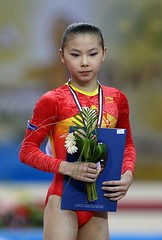
He Kexin's Allegedly Falsified Passport


GYMNASTICS-QATAR-AUS-HE
Originally uploaded by photo240779
The China Digital Times has come up with some very convincing evidence that Chinese gymnast He Kexin who did so well in the Olympics winning a gold medal is 14 years old when the minimum age to compete is 16. The item can be found at: http://chinadigitaltimes.net/2008/08/another-olympic-secret-how-old-is-he-kexin/

Evidently the IOC goes by the age listed on the athlete's passport which gives her date of birth as January 1, 1992, but the CDT has found a number of news articles and other documents that suggest that Ms. He's date of birth is in fact January 1, 1994. If the passport date of birth has been falsified this would suggest Chinese Government collusion in this fraud (most likely without the knowledge of senior level Communists).

This unexpected incident has enormous explosive potential as Chinese people everywhere who are so proud of China's hosting of this important international event will feel great loss of face if He Kexin has her gold medal taken away. It will be much worse than when Canadian Ben Johnson was revealed to be a cheat at the '88 Olympics and lost his medal. "Face" is such strong imperative in Chinese culture.

I also feel sorry that the matter involves a child who will suffer stigma for the rest of her life, despite being too young to be held in any way responsible for the alleged fraud, if it turns out to be proven definitively that she is in fact underage for the competition.

The whole thing is just so regrettable.


Update October 1, 2008: The IOC has ruled that the  Chinese female gymnasts who competed at this year's Beijing Olympics were not underage:  http://news.yahoo.com/s/nm/20081001/ts_nm/us_gymnastics_china


Tuesday, August 12, 2008

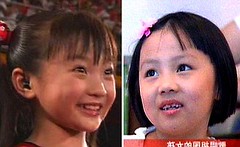
I Think Chubby Face and Uneven Teeth Also Cute and Sweet and More Talented and Politburo Made Wrong Call


BEIJING (AFP) - The little girl who starred at the Olympic opening ceremony was miming and only put on stage because the real singer was not considered attractive enough, the show's musical director has revealed,

Pigtailed Lin Miaoke was selected to appear because of her cute appearance and did not sing a note.

But Chen Qigang, the general music designer of the ceremony said the girl whose voice was actually heard by the 91,000 capacity crowd at the Olympic stadium during the spectacular ceremony was in fact seven-year-old Yang Peiyi, who has a chubby face and uneven teeth

The reason why little Yang was not chosen to appear was because we wanted to project the right image, we were thinking about what was best for the nation," Chen said in an interview that appeared briefly on the news website Sina.com before it was apparently wiped from the Internet in China.

He said the final decision to stage the event with Lin lip-synching to another girl's voice was taken after a senior member of China's ruling Communist Party politburo attended a rehearsal.

"He told us there was a problem that we needed to fix it, so we did," he said, without disclosing further details of the order.

The Beijing Olympic organising committee confirmed the episode.


http://ca.news.yahoo.com/s/afp/080812/world/oly2008_china_ceremony_song_fake

Monday, August 11, 2008

Canada-China Relations Then and Now

My good friend, Wenran Jiang of the University of Alberta has put forth that Canada-China relations are presently at their lowest point since Canada established diplomatic relations with China in October 1970. I am not sure what criteria Wenran is using to assess this. To me it is is hard to square with the impact that the pervasive xenophobia of the Chinese régime of the 1970s had on Canadian interests in the PRC in the 1970s. In those days Canada was really constrained in what we could do in China. For example:
Political: we had very limited access to Chinese citizens and very little access to Chinese publications due to the restrictive laws and regulations of that time. Canadian reporters could be expelled peremptorily for very gentle truth telling about the negative side of the Cultural Revolution.
Immigration: we had a lot of trouble getting the Chinese authorities to implement our family Reunification Program. Canadians with valid reasons for wanting to enter China were usually denied visas.
Trade: we could not get fair access to the Chinese market, except for some grains, minerals and newsprint. The non-market currency exchange rate made Canadian products very expensive in China.
Culture: we could do virtually no public diplomacy
Development: we were not allowed to do CIDA projects despite China's great need due to the pervasive poverty in China in those years.
And so it goes.

Essentially the context of China under Maoist revolution was so completely different that there is no valid basis for comparison.

Sunday, August 10, 2008

Fragment of Statement by the Uyghur American Association Condemning Violence

The Uyghur American Association (UAA) resolutely condemns the message delivered in a terror video just released and dated August 1, in which a man speaking in Uyghur claims to be part of a so-called the Turkistan Islamic Party. UAA condemns any groups that promote terrorism or violence, and opposes the threats of violent attacks that are presented in the video.

"The goal of our organization, and of the vast majority of Uyghurs around the world, is to peacefully resolve the problems facing Uyghurs in East Turkestan," said Uyghur freedom movement leader Rebiya Kadeer. "We advocate the principle of non-violence, and the promotion of freedom, democracy and human rights through peaceful means. We also sincerely hope for a peaceful Olympic Games."

UAA urges caution with respect to claims circulated in the media regarding the Turkistan Islamic Party, as the existence of the group, its size and level of organization and any reported links to al Qaeda have yet to be confirmed. UAA maintains a degree of skepticism that this group exists beyond the Internet. UAA is also unaware of any mention of the Turkistan Islamic Party prior to last month, when a separate video was released that was reportedly also produced by the organization. Prior to the release of this video, UAA had never heard of the group. In addition, UAA urges the international community not to discount the possibility that the Chinese government itself may have been involved in the production of the video.

UAA also urges a high degree of caution when assessing recent assertions by Chinese government officials regarding the existence of a well-organized terrorist group or groups in East Turkestan, as these assertions have yet to be independently verified. UAA also urges skepticism with regard to official Chinese claims of a strong linkage between al Qaeda and alleged Uyghur terrorist groups, which have similarly remained unsubstantiated.


Comment by me: Violence in Xinjiang only makes the situation there worse.

Thursday, August 07, 2008

China Foreign Ministry Spokesman on U.S. President's Comments

clipped from news.yahoo.com

China on Bush: Don't interfere in our affairs


Thu Aug 7, 5:49 AM ET


China has responded to President Bush's speech criticizing Beijing for repression, saying no one should interfere in other countries' internal affairs.

Foreign Ministry spokesman Qin Gang said China and the United States have divergent views on human rights and religions issues, but said Beijing firmly opposed "any words or acts" that used those issues to interfere in other countries' internal affairs.

 blog it

Friday, August 01, 2008

Archbishop of Uganda, Henry Luke Orombi's Observation on the Anglican Communion


Anglicans may say there are four “Instruments of Communion,” (the Archbishop of Canterbury; the Lambeth Conference; the Anglican Consultative Council and the Primates' Meeting). But de facto, there is only one - the Archbishop of Canterbury.

The peculiar thing is that this one man, who is at the centre of the communion's structures, is not even elected by his peers. Even the Pope is elected by his peers, but what Anglicans have is a man appointed by a secular government. Over the past five years, we have come to see this as a remnant of British colonialism, and it is not serving us well. The spiritual leadership of a global communion of independent and autonomous provinces should not be reduced to one man appointed by a secular government.

It is important that our decision not to attend this Lambeth Conference is not misunderstood as withdrawing from the Anglican Communion. On the contrary, our decision reflects the depth of our concern and the sober realisation that the present structures are not capable of addressing the crisis.
(published in the London Times this morning: http://www.timesonline.co.uk/tol/comment/columnists/guest_contributors/article4438729.ece) Photo from http://www.churchofuganda.net/homepages.php?pid=9

Saturday, July 19, 2008

Fragment from Washington Post Editorial on Mr, Bush's Trip to Beijing

Mr. Bush has confirmed that he will join Zimbabwe's Robert Mugabe and Cuba's Raúl Castro in attending the Opening Ceremonies because he wishes "to cheer on our athletes" and because to do otherwise "would be an affront to the Chinese people." In fact, Mr. Bush is affronting those Chinese who have bravely tried to resist the regime's steamrolling of all dissent. And what if an intrepid protester manages to raise his or her voice for Tibet or religious freedom or an end to China's sponsorship of genocide in Darfur and is swarmed by the regime's thugs? What if Western media seeking to cover such an event are censored? We can only hope that in that event, Mr. Bush will stop cheering.

http://www.washingtonpost.com/wp-dyn/content/article/2008/07/17/AR2008071702679.html


July 25: An interview with me about this is quoted in Michelle Collins "Beijing Olympics:To Attend or Not to Attend?" in the July 23 Embassy: Canada's Foreign Policy Newsletter available at:
http://www.embassymag.ca/html/index.php?display=story&full_path=/2008/july/23/olympics/

What Will Be the Legacy of the Beijing Olympics?

While the games have yet to begin, it is already apparent that when the games are over, China's reputation in the world will not have been enhanced. Despite the massive investment in the Games that the Chinese Communist Government has made, China's image abroad has suffered badly due to the fiasco of the Olympic Torch relay. People throughout the world who previously were open to being convinced that China had "arrived" as a modern great nation now see China as a politically repressive, badly governed, authoritarian regime with serious environmental issues, especially if some of the Olympic events are postponed due to pollution. As the start of the Games approaches it appears unlikely that this negative impression will change and could well get worse if there are incidents at the Games that show the Chinese police acting with violence.

Most ordinary Chinese people are deeply offended at the West's support for the Tibetans and generally negative attitude toward their Government. So the Games have had the effect of increasing anti-Western nationalistic sentiment in China. This does not bode well for political liberalization in China in the years ahead.

Thursday, July 17, 2008

History and Victimization by the "Anti-China West"

I had some correspondence with some one I do not know who reads this blog and other things written by me available on the internet. He described him or herself as a "typical Chinese" aged 31. My correspondent is vitriolic in attitude to the Dalai Lama and appalled at the protests against the Olympic torch relay. He also feels that the West had blackened the reputation of Chinese products by over-dramatic reaction to the problems of lead paint found on toys, etc.

Here is a summary of my responses to him or her:
Much of his anger he traces back to the ravages of Western imperialism on China starting with the First Opium War of 170 years ago. I am with him on the idea that establishment of colonies and treaty ports in China was not a good thing by today's standards of assessment. But I would also say that it is also not good to have a "victimization" mentality which seeks to blame these historical events for China's political shortcomings today (as measured by UN Covenants, I mean). Basically the situation in China today is really about domestic factors. The really damaging events in recent history such as the Heavenly Kingdom of the Taipings Rebellion, failure of the 1911 Republic and lapse into warlordism,the Anti-Japanese War, the political persecution of innocent people in the political campaigns of the '40s, '50s, '60s, '70s, and '80s, the terrible famine incurred by the enormously tragically wrong-headed policies of the Great Leap Forward Campaign, the destruction of so many books, ancient buildings and artefacts in the Cultural Revolution etc. did not involve actually "the West" in a negative role. The Korean War can be an exception to this and close to a million Chinese lives were lost (although you don't see much acknowledgement by the DPRK authorities of this huge sacrifice made be the PLA "volunteers") But basically the people in South Korea are a lot better off than those living in a kind of political hell in the North so historical verdict would not see China supporting the North as such a good choice in today's terms.

Essentially Chinese people are responsible for China's issues today and the solutions are domestic too.

But the "China will eventually become democratic some time after Burton is dead" concept that my correspondent espouses is not one I find too reassuring. I would be more convinced if there were some signs that there is progress in this regard, but they are hard to find in a one-Party state with such efficient mechanisms for suppression of political dissent.

The Tibet issue to Tibetans is not really about how much worse the pre-1959 Dalai Lama regime was than Han rule today. Tibetans yearn for recognition of their identity and culture. It is not about their rational self interest. I judge that they will never give up their resistance to Han domination of what they regard as their sovereign native territory. Same goes for Uyghurs. International interest In these matters is based on universality of human entitlement to rights expressed in international Covenants.

A lot of people in the West believe that China should not use the Olympics to affirm moral claims in state behaviour at this time (including in Sudan, Burma, etc.). They do not want the Olympics to be a celebration of the current political regime.

The quality and safety problems with some Chinese imports are valid, but there are international institutions and the market to address these. There used to be issues in quality shortcomings in Canada wheat exports to China that were addressed this way too.


My conclusion:
I like hearing from Chinese people who challenge what I write about China here and elsewhere. There are always more things to talk about.

Saturday, July 12, 2008

Tragic Death of Diana O'Brien

The death of Diana O'Brien in Shanghai earlier this month has been given a lot of prominence in the Canadian media. From what I can piece together based on Geoff York's insightful piece about it in the morning's Globe, the alleged murderer, Chen Jun, a migrant worker from a poor village in Anhui, just 18 years-old, had recently been fired from his job in a restaurant near where Ms. O'Brien was lodging in Shanghai. The reason he was let go is because he is too klutzy and shy to do the job properly. So with no job and no money, he turned to petty theft to make ends meet.

Chen forced himself into Ms. O'Brien's apartment as she was unlocking the door to her place after she came home one evening. He threatened her with a knife and gathered up her laptop computer and camera. But unlike most Chinese victims of this sort of crime, instead of just letting him take the stuff and telling him to get out, Ms. O'Brien fought with him and chased Chen Jun down the stairs as he took off with a bag full of her modest possessions. In a panic, Chen then stabbed her to death in the stairwell. It was several hours before anyone noticed that Diana O'Brien had been killed. I do feel very sorry about this.

Chen Jun's story reveals that behind the facade of wealth and modernity in Shanghai most of the people living in that city are poor and scrambling to get by often in desperation. As one of my old friends in Shanghai wrote me about it in an e-mail this morning: "Shanghai is somehow very like what as Dickens wrote about of the 19th century London!"

Canada should thank the Chinese police for their work in solving this case. I also hope that the Canadian Consulate in Shanghai will request permission to attend the accused's trial with a view to ensuring that Chen Jun gets due process and that Diana O'Brien's family and friends can be assured that the true murderer is being held.

It is most likely that Chen Jun will be sentenced to death for the murder of Diana O'Brien. But I don't think that Mr. Chen deserves to die for what he is alleged to have done considering the circumstances.


March 13, 2009: News reports are that Chen Jun was sentenced to death but the execution delayed for 2 years. I suppose that this means that he will be get life imprisonment if his behaviour in prison is deemed "good" after the two years: http://www.ctv.ca/servlet/ArticleNews/story/CTVNews/20090313/china_model_090313/20090313?hub=TopStories

Monday, July 07, 2008

My Answers to Questions on Canada-China Relations Posed by a Student at McGill

Is it accurate to say that Chinese-Canadian relations are usually warmer under a Liberal government as opposed to a Conservative one? If so, why do you think that is the case?
That would not be accurate to say
because since 1970 we have had 4 Conservative Prime Ministers: Joe Clark, Brian Mulroney, Kim Campbell and Stephen Harper. Clark, Mulroney and Campbell did not have China policies much different from those of Trudeau, Turner, Chretien and Martin. Stephen Harper's less compromising stance on China's poor compliance with some international norms for state behaviour is part and parcel of his overall approach to government. But this is not to say that it is not associated with changing international dynamics that transcend partisan politics. So under a future Liberal government the Harper-initiated approach could be continued.

Do you agree with the statement occasionally made in the Canadian media that, as Jeffrey Simpson put it, Chinese-Canadians “overwhelmingly” vote Liberal. If so, why do you think this is the case?
I am not too familiar with the statistics on voting behaviour of self-identified ethnic groups in Canada, although I have heard this before from both Liberals and Conservatives. There is a perception that Chinese-Canadians feel grateful for Government programs facilitating migration from China to Canada that they identify with the Liberal Party.
The hard work of the Conservative Government's Secretary of State for Multiculturalism and Canadian Identity, Jason Kenney appears to be changing this perception. I understand that Michael Ignatieff plans to spend much of the summer making appearances to counter Conservative Party progress in establishing strong relations with self-identified Canadian ethnic groups.

Why do you think Harper toughened Canada’s stance towards China in 2006?
I think his motivations were to better reflect his own and Canadians' values on the moral imperative to stand with Chinese people whose entitlements to human rights have been repressed by the Chinese Communist Party's policies. My 2005 report for DFAIT that showed that the "quiet diplomacy" of the Bilateral Human Rights Dialogue was ineffective may have made a small contribution to the policy debate.

There have been suggestions that a large part of Harper’s hardened stance towards China had to do with domestic politics. For example, some have said it is partly a Conservative attempt to win over the segment of Chinese-Canadians critical of the regime so as to undercut the Liberals’ electoral success with that ethnic group. Another view suggests that it is an attempt to reclaim the “human rights mantle” the Liberals have supposedly possessed since the Trudeau era. How much of the policy switch towards China do you think was motivated by domestic politics?
It has been good domestic politics as public opinion polling shows that most Canadians want Canada to be frank and transparent in its approach to China on human rights. But most recent immigrants from China do not support this approach. So I think it is more about doing the right thing for Canada than anything else.

Has Canada’s firmer stance with China over the last two years been more or less effective at bringing about positive domestic reform within that country than the bilateral human rights dialogues were? Or have the effects of both approaches been negligible? Are all of these approaches merely devised to make it appear like Canada’s politicians are doing something about human rights abuses in China or are they genuine attempts to bring about reform within that country? How realistic do you think it is that a middle power such as Canada could actually influence domestic reform in China?
Chinese domestic factors are the most critical for determining China's political destiny. It is important that Canada not be complicit in supporting non-democratic institutions by standing idly by and tacitly accept attempts by the Chinese regime to put forward a moral equivalence of their political institutions and ours. Our Parliament and their National People's Congress for example are by now means comparable
. We should not leave any impression that Canada accepts them as only varying due to cultural and historical factors. The Chinese regime clearly does not like the dark side of their regime such as repression of freedom of expression, freedom of association, brutal suppression of dissidents to be known in the West. So being open and frank about our concerns is a way to disincentive this sort of thing. But it is Chinese people in China that will bring China to democracy. The best we can do is to support agents of change in ways consistent with international norms of interaction between sovereign states. And we expect the Chinese Embassy to Canada to behave in ways consistent with international diplomatic treaties and not attempt to intimidate Canadians of Chinese origin in Canada or engage in espionage here.

Why has the Lai Changxing case been largely overlooked by both journalists and politicians alike when examining the current poor state of Canada-China relations? The common narrative presented by the media is that the decline in Canada-China relations began in early 2006 when the newly elected Conservative government toughened Canada’s approach with China. Another perspective relayed to me by a former bureaucrat with connections in the Chinese government was that, in fact, the decline in relations began near the end of the Chretien government. Supposedly, during a meeting between Chretien and former Premier Zhu Rongji, Chretien made the error of suggesting that as long as the Chinese government promised to waive the death penalty for Lai Changxing, Canada would, in return, extradite him to China. When the Lai case continued to make little headway in Canadian courts, even after the Chinese made the exemption Chretien sought, the relations between the two countries soured because the whole affair was seen as a breach of faith by Chinese officials. Seen from this perspective, Harper’s policies have really only aggravated an already declining relationship. Do you think there is any validity to this interpretation? How much of an impact do you think the Lai case has had on China-Canada relations? How realistic do you think the suggestion is that if Canada were to, hypothetically, extradite Lai Changxing tomorrow we would suddenly see progress on a variety of issues currently dogging relations such as the Celil affair or China’s reluctance to grant Canada “Approved Destination Status”?
I agree that the Lai case was bungled by the Liberals and bureaucracy. They should have appreciated that the Canadian judiciary might render judgements making it impossible for Lai to be returned to China. So we raised Chinese expectations that they would get Lai back and now the Chinese authorities feel betrayed by us. ADS is said to be related to the Lai case, but another factor might be the Canadian refugee determination system in general that has led to a large number of corrupt Chinese officials and criminals being able to escape being made accountable to Chinese justice permanently by touching base in Canada and making a refugee claim. Not sure that there is much basis for characterizing Canada-China relations as "poor." But Canadian exports' share of the Chinese market has been declining for more than 10 years, so I would take that as an objective indicator of something being not right.

How damaging has the ongoing Celil affair been on Sino-Canadian relations? How far should Canada go to achieve Celil’s release to the detriment of Sino-Canadian relations at large?
I don't think that the Celil affair has damaged overall Sino-Canadian relations
. I think we should do everything we can consistent with international diplomatic norms to get the Chinese Government to accept that Mr. Celil is a Canadian and address his case in accord with international standards for foreign nationals arrested outside their home country. I don't think we should ever give up.

When quoted in a Maclean’s article two years ago (RE: Tories Deadlocked over Canada-China Relations, November 2006), you suggested that Canada’s firmer stance towards China, particularly regarding human rights concerns, would likely not affect trade between the two countries because the Chinese rarely linked the two issues together. In a Globe and Mail essay recently, Peter Harder suggested that the continuing chill between Canada and China, which many attribute to Harper’s tougher stance on human rights, is now resulting in lost contracts for Canadian companies doing business in China. Do you think that your original assessment two years ago still rings true or has it changed at all? How effectively has Canada harnessed the increasing trade opportunities presented by China’s economic rise in recent years when compared to other industrialized nations such as Australia? Are we remaining competitive or are we lagging behind?
Mr. Harder was unable to provide any evidence to back up this claim. So I think my original assessment remains unchallenged. Canada's approach to trade promotion is rather fragmented in that the DFAIT, EDC, Provincial Economic Offices and CCBC do not coordinate their efforts very well. We also lack expertise in Chinese and cultural knowledge compared to the Trade Promotion people in Australia. We are definitely lagging behind. I don't see the problem so much as attributable to Mr. Harper as to Mr. Harder himself as a director of CCBC.

Do you think that recent developments this year such as the opening of new trade consulates, the expressed support of the “One China” policy, and the appointment of David Emerson to Minister of Foreign Affairs, are indications that Canada is softening its stance with China? Does this constitute an affirmation that Canada’s China policy over the last two years has been ineffectual?
No. I don't. The "One China" policy may not have much presence in what we do with China. I personally see it as inappropriate because this issue is a domestic Chinese concern. Conversely, China does nor have a "One Canada" policy, nor should they. I think the new trade offices will only be effective if we put the right people into them.

Do you agree with Harper’s decision to not attend the opening ceremonies of the Olympic games? Why?
Olympic opening ceremonies function as a celebration of the host nation. There is no tradition of foreign leaders attending them. Mr. Harper indicated that he has other commitments on August 8. But Canada will send Cabinet-level representation to the ceremony.


Thursday, July 03, 2008

China Nationalist's Interpretation of Increase in Price of Oil

A Chinese friend explained to me today that the United States is purposefully artificially inflating the world price of oil as means to force China to raise the value of the RMB yuan. The increase in the price of oil will also make the cost of production of Chinese products more expensive and therefore render them less competitive in the U.S. market. Furthermore igher oil prices increase the cost of shipping products from China to the United States. So all three factors will make Chinese products less competitive in the U.S. market.

To most Canadians this interpretation is rather far-fetched and irrational. But to the Chinese nationalist's mind when things go wrong, such as gas prices going up by 18% as they have in China recently, the default response is to blame it on hostile foreign forces. The idea in this case is that hostile elements in the United States are manipulating world oil prices as a means to make problems for China. I strongly suspect that this may be in interpretation that many Chinese would readily accept without question.

Irrational nationalism can be a very dangerous thing.

Tuesday, July 01, 2008

David Emerson is a True Mandarin?

Gary Mason's column in Saturday's Globe and Mail entitled "Will Emerson re-enter the fray in a new riding?" (p.A11) says: "Mr. Emerson speaks fluent Chinese and is married to a Chinese-Canadian."

Seems that the Canadian Minister of Foreign Affairs and I are more alike than I had previously been aware!

A fluent Mandarin speaking Minister of Foreign Affairs would certainly be a great boon for Canada.

Strange that this information about David Emerson's fluency in Chinese does not seem to have been reported in any of the Canadian-Chinese media reports about our new Foreign Minister that I have seen.

This claim in The Globe and Mail about Mr. Emerson reminds me that in years past the Chinese media reported that the Chinese Premier at the time, Zhou Enlai, was fluent in 8 languages. But despite his alleged amazing linguistic skills. he used interpreters in his meetings with non-Chinese as a way to gain strategic advantage in negotiations.

Tuesday, June 03, 2008

Summary of recent events of Commons Foreign Affairs Committee Study on Canada-China Bilateral Human Rights Dialogue

I spoke to the Committee on April 17 (http://cmte.parl.gc.ca/CMTE/CommitteePublication.aspx?SourceId=235986&Lang=1&PARLSES=392&JNT=0&COM=13185)

They met to consider the report on April 29

May 1st met again and decided to hold two more meetings on the Report to hear from further witnesses

May 27 heard from:
Gregory T. Chin, Assistant Professor, Faculty of Graduate Studies and Department of Political Science
(worked for China Division of DFAIT and for CIDA in Beijing);
Bernie Michael Frolic, Professor Emeritus, Political Science Department;
Jeremy Paltiel, Professor, Carleton University;
Pitman Potter, Professor of Law and Director of the Institute of Asian Research , Director of Chinese Legal Studies, Centre for Asian Legal Studies, UBC;
Daniel C. Préfontaine, President., International Centre for Criminal Law Reform and Criminal Justice Policy
(http://cmte.parl.gc.ca/CMTE/CommitteePublication.aspx?SourceId=242499&Lang=1&PARLSES=392&JNT=0&COM=13185)

May 29 heard from:
Thomas In-Sing Leung, Professor
Culture Regeneration Research Society;
Rev. Jian Miller Zhuang
.
(http://cmte.parl.gc.ca/CMTE/CommitteePublication.aspx?SourceId=242825&Lang=1&PARLSES=392&JNT=0&COM=13185)


May 27 decided that the Committee continue studying the draft report on Afghanistan during the meetings on June 3 and June 5, 2008 and that the Committee continue studying the draft report on Afghanistan during the meeting of June 10, unless they have completed the report and then they will continue studying the draft report on China.


http://cmte.parl.gc.ca/cmte/CommitteeList.aspx?Lang=1&PARLSES=392&JNT=0&SELID=e22_.2&COM=13185&STAC=2422146